
Had my exam 1 on friday, some really nice crits were there: Mark Delaney from Plan Design, Jay Melican from Intel research, Chris Downs from Live|Work and Steve Thompson from Newport School of Art and Design in Wales.
I hate to say the critique was very harsh and pointed out some really important gaps in my thinking , maybe related to the fact that i had so little time to prepare for this exam, right after Salone. Well that’s no excuse really. So i thought id make a diagram of the foundation of my thesis so i avoid having to discuss it again and can go: here it is and avoid a lot of communication problems i encountered in my presentation.
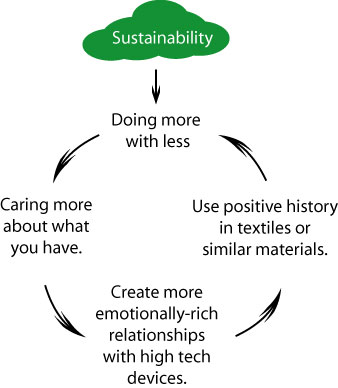
So essentially I am looking at sustainability and the ways in which our society is supposed to address it. Through concepts like PSS (Product Service Society and service design, we are advocating that we should do more with less; use more services and less material objects, transition from a society that values access versus ownership. I think that this is a very valuable way of looking at the future but it hardly addresses the designer’s role and how we design within and for these services. If we are advocating that we should use less, does that mean that we should care more and therefore throw away or discard less? When we talk about high tech personal devices, we often find ourselves with a little bit of ause-phobia mainly because use and the degradation of those objects is not something that is desirable or appealing. I am calling this negative history. What i seek to find out is if we can design for “positive history” or to create meaningful object-subject relationships by using and treating fabrics as a material that displays history in an appealing and engaging way. History of use is something desirable in a pair of jeans or a teddy bear, so why not in a high tech device?
To test this theory out, i wanted to find a design space that would allow me to address mack of emotional relationships and i found that the area of music and its more recent form the mp3 and its player was a convenient case study. With the disappearance of a physical token for music and an ephemeral attachment to its containers, this was the perfect area to start.
So there, I have laid down the foundation of my thinking for this thesis and can now concentrate on the design work that is necessary for the next review which will take place on the 15th and 16th of June 2006.
Discover more from designswarm {thoughts}
Subscribe to get the latest posts sent to your email.
1 comment
Comments are closed.